
Control your entire fleet.
On your server.
The open-source, self-hosted remote desktop for the devices you own. One hub, a tiny agent per machine, one dashboard — terminal, screen, files, whole-fleet commands, and an AI copilot. Direct, encrypted, device-to-device. No third-party servers, no per-seat fees.
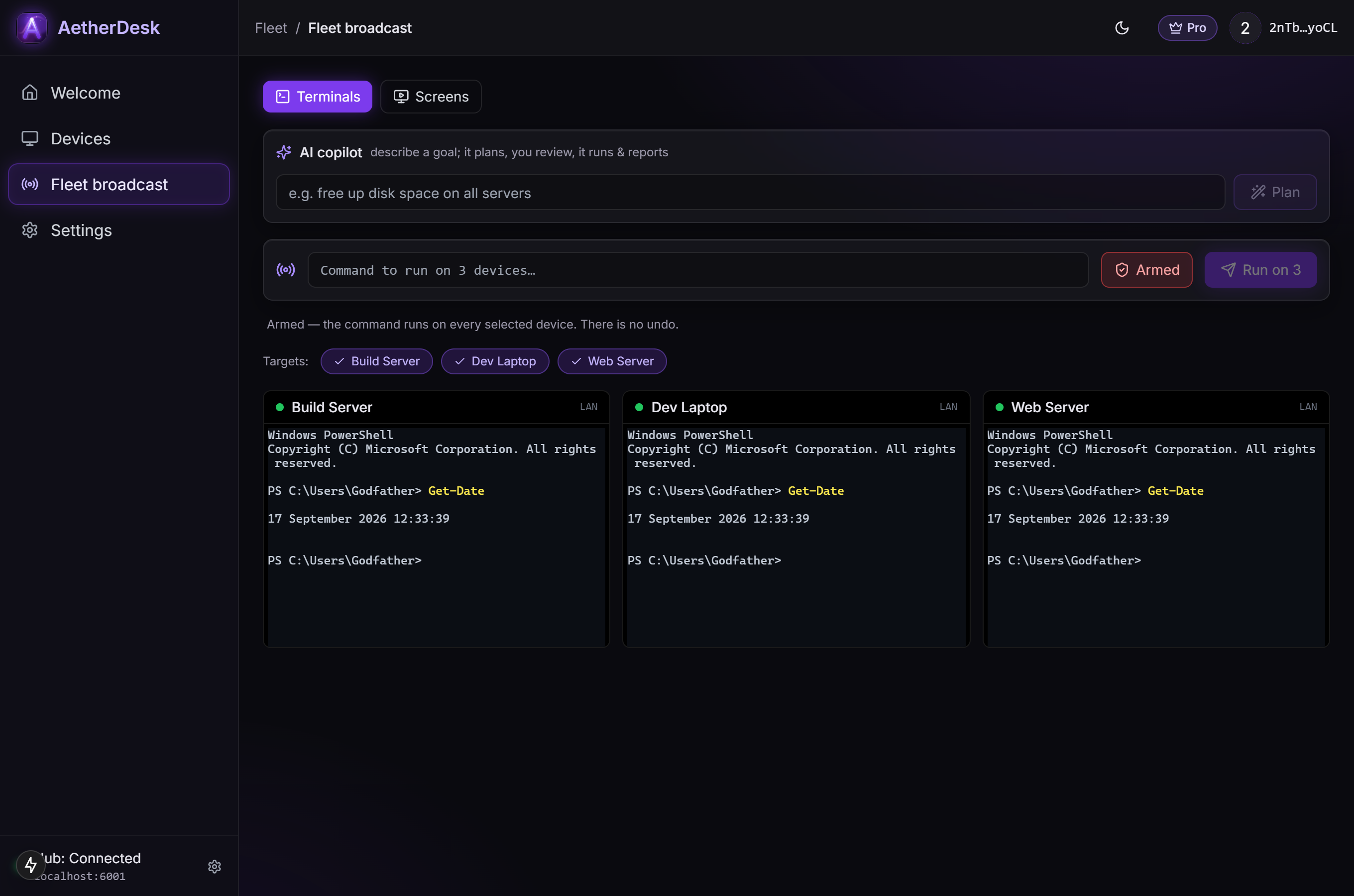
One command, every device — real terminals across a live fleet, connected peer-to-peer, output captured per device.
No public IP.
No port forwarding.
No problem.
Every other self-hosted tool assumes a server with a public address and an open port. AetherDesk doesn't. Publish your hub as a private .onion address over the Anyone privacy network, and your agents reach it through an encrypted onion tunnel — from a laptop, a Raspberry Pi, or a box behind CGNAT.
- No public IPThe hub never needs an inbound address. Agents find it by its private .onion name.
- No port forwardingNo router config, no firewall holes, no dynamic DNS to babysit.
- Works behind CGNATHome internet, a Raspberry Pi in a drawer, a mobile hotspot — all fine.
- Onion-routed & encryptedThe control path rides the Anyone privacy network — who connects to whom stays private.
Only the control path is onion-routed — live screen & terminal still take the fast direct-P2P / relay path.
Everything you do, in one dashboard
Five surfaces, one wallet, your whole fleet. Hover to explore.
What TeamViewer & RustDesk can't copy
Structural choices at the core — not features on a roadmap.
Self-hosted, not someone's cloud
You run the hub — on a VPS or a spare box at home. Your sessions never touch a third-party server. No per-seat fees, ever. A promise TeamViewer and AnyDesk structurally can't make.
Direct peer-to-peer
Traffic goes straight device-to-device over an encrypted WebRTC channel, with the hub as relay fallback only. Fast, private, and it just works behind NAT.
A fleet, not a support call
Every competitor is built for one human helping another for five minutes. AetherDesk is built for one person orchestrating their own fleet — broadcast, automation, and an AI control surface.
Tell your fleet what to do.
In plain language.
Describe a goal — “free up disk on the build servers”, “roll out the patch everywhere”. The copilot drafts a step-by-step plan, you review and arm each step, and it runs across every selected device and reports back what happened on each one. Built for owning a fleet, not making a support call — the one thing an incumbent built for 1:1 sessions can't bolt on.
- Plans, you approve — It proposes the commands; nothing runs until you arm and confirm.
- Runs across the fleet — One plan fans out to every selected device over the direct channel.
- Reports per device — It reads each machine's output and tells you what succeeded and what didn't.
The API key stays on your hub. Destructive steps are refused, never auto-run.
Web Server — 3.1 GB freed
DB Primary — already clean
Not another support tool
RustDesk is the closest open-source peer — and we're fans. Here's where AetherDesk goes further.
| AetherDesk | TeamViewer | RustDesk | AnyDesk | |
|---|---|---|---|---|
| You self-host it | ||||
| No per-seat fees | ||||
| Direct P2P + relay fallback | ||||
| Runs behind NAT — no public IP | ||||
| Whole-fleet broadcast | ||||
| AI fleet copilot | ||||
| Wallet identity — no accounts | ||||
| Open source |
Comparison reflects each tool's standard offering; competitor features change — check their current docs.
Everything you need to run your fleet
Terminal control
A live shell on any device — type, run commands, and read output in real time, with scrollback restored on reconnect.
Screen + input
Stream a device's screen over WebRTC (H.264) and drive its mouse and keyboard, with low latency.
File transfer
Drag-and-drop a file onto a device, or pull one back by path — straight over the direct channel when it's up.
Fleet broadcast
Run one command across many devices at once, watch a live screen wall, with an arm-and-confirm safety gate.
AI copilot
Describe a goal; it plans the steps, you review and run them, and it reports what happened on each device.
Direct & private
Sessions go device-to-device over an encrypted WebRTC channel with relay fallback. You run the hub — no third party.
Real commands. Real output.
One CLI drives your whole fleet — run a command everywhere, open a live screen over direct WebRTC, push a file down the P2P channel. This is the actual flow, playing out end to end.
- Fan out to every device — One command, per-device output, in one place.
- Direct WebRTC control — Low-latency screen + input, negotiated peer-to-peer.
- Files over the same channel — No cloud hop — straight device-to-device.
See the actual app
Real screenshots from a running hub with a live fleet — no illustrations.
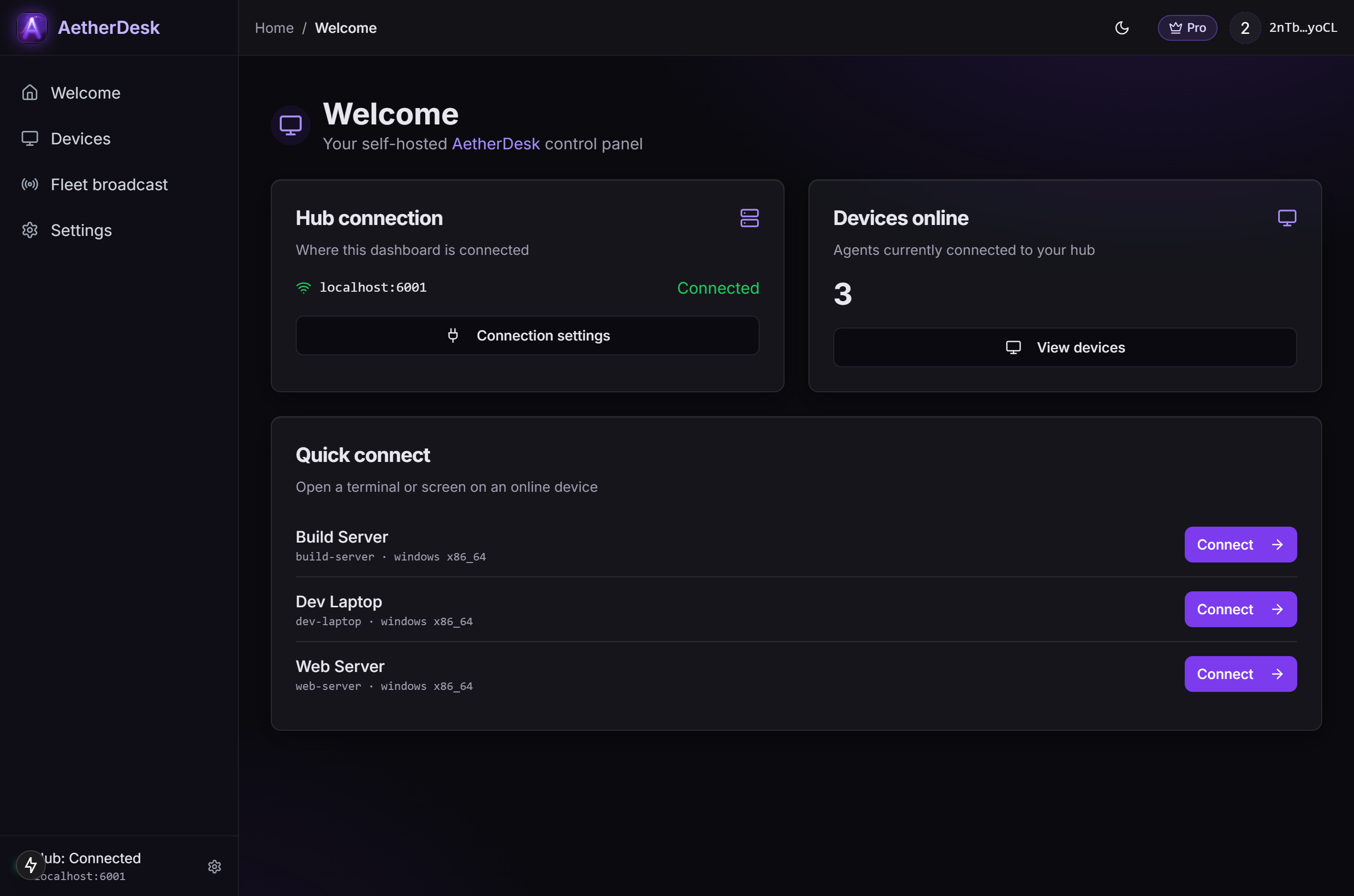
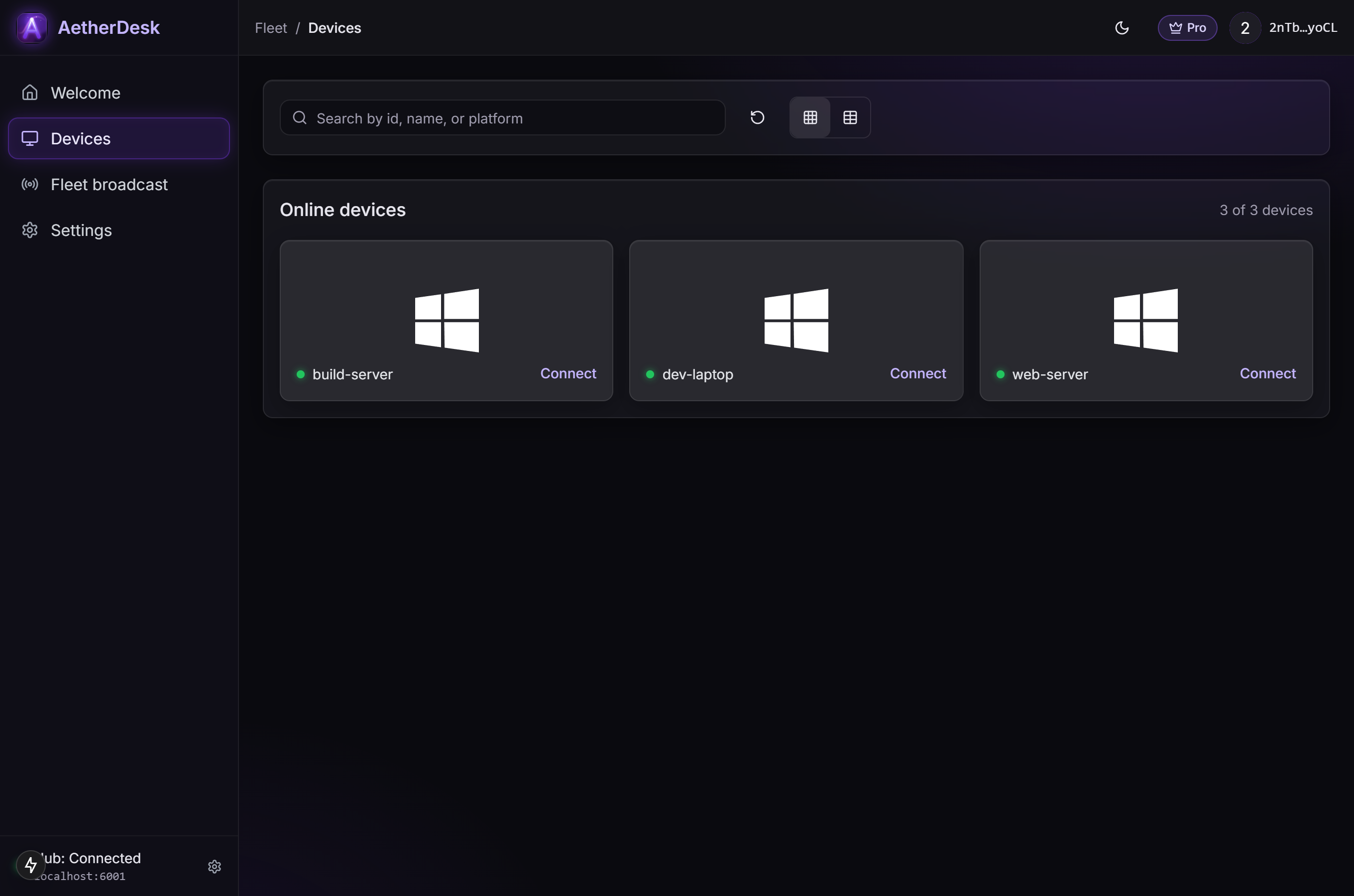
Control panel — Hub connected, your whole fleet online, one click to drive any device.
Your wallet is your identity
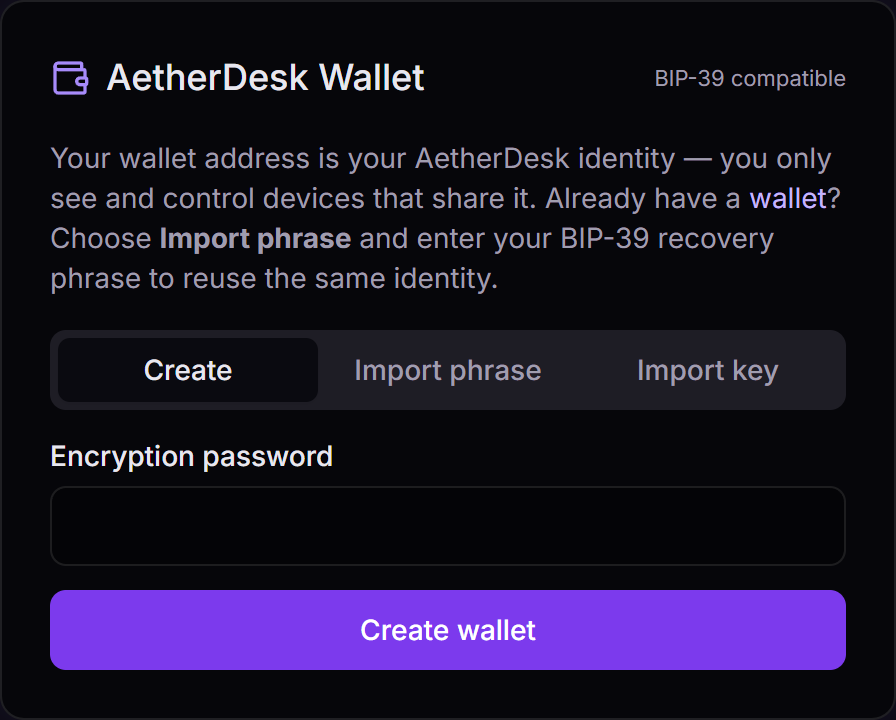
AetherDesk authenticates every device with a wallet signature — no accounts, no passwords on a server. The same recovery phrase across your machines means they share one fleet automatically. Bring your own wallet: import a standard BIP-39 recovery phrase and it's the same identity everywhere.
- Sign-in by wallet signature — The hub verifies a challenge — nothing to leak.
- Wallet-scoped fleet — You only see and control devices that share your wallet.
- One seed, many devices — Add a device by importing the same recovery phrase.
Private by construction, not by policy
Privacy isn't a setting you trust us to honour — it's the architecture. Four layers, all yours.
Self-hosted by design
The hub runs on your box. Sessions never touch a third-party server — no vendor in the middle to trust, breach, or subpoena.
Encrypted transport
Screen and input ride WebRTC's DTLS/SRTP; the data channel is encrypted too. Traffic goes device-to-device, not through a cloud.
Wallet-based auth
Devices sign a challenge with an Ed25519 key — no passwords stored on a server, nothing to leak. Your fleet is scoped to your wallet.
Optional onion privacy
Route the control path over the Anyone network for IP privacy and to reach a hub with no public IP. Media stays on the fast direct path.
Free to self-host. Pay only for the cloud bits.
The core is open source and free forever. Premium features that run on the hub unlock with your wallet.
Free
- Unlimited of your own devices
- Terminal, screen, files
- Direct P2P + relay fallback
- Wallet identity
Pro
- Everything in Free
- AI fleet copilot
- Hosted relay + session recording
- Universal clipboard & handoff
Team
- Everything in Pro
- Multiple operators + roles
- Audit log
- SSO & priority support
Up and running in three steps
Run the hub
Start the self-hosted coordinator — a single binary — on a VPS or your home server.
Enrol your devices
Install the agent with the one-click setup app (or a single command) and sign in with your wallet.
Take control
Open the dashboard, pick a device or your whole fleet, and drive its terminal, screen, and files — from anywhere.
One tiny agent, everywhere
Install the AetherDesk agent on any machine — a one-click setup app or a single command. Built in Rust: tiny and dependency-free.
Agent, Controller & Hub — Windows, macOS & Linux.
Questions, answered
Do I need a server with a public IP?
No. Run the hub on any box — a VPS, a home server, even a laptop behind CGNAT — and reach it over the Anyone network as a private .onion service. A public IP and port-forwarding are optional, not required.
How is it secured?
Sessions go device-to-device over encrypted WebRTC (DTLS/SRTP). Devices authenticate by signing a challenge with your wallet key — no passwords are stored on a server. You host the hub, so no third party sees your traffic.
What does it cost?
The core is free and open source (AGPL-3.0), forever. Pro features that run on your hub — the AI copilot, hosted relay, session recording — unlock with your wallet.
Which platforms are supported?
Windows, macOS, and Linux. The agent is a tiny Rust binary you install with a one-click setup app or a single command.
Is any of my data sent to AetherDesk?
No — there is no AetherDesk cloud. Everything runs between your own devices and the hub you run.
Can I use my existing wallet?
Yes — import a standard BIP-39 recovery phrase and it's the same identity across every device.
Own your remote access
Free and open source. Your devices, your server, your keys. Join the closed beta and be first in when it opens.